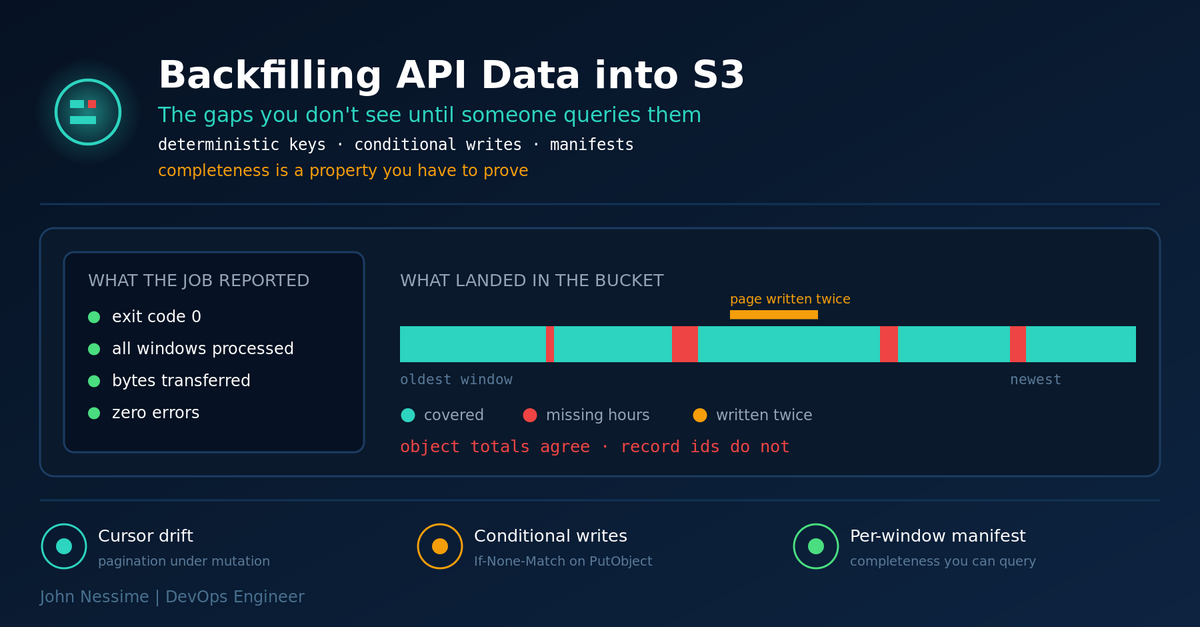
The backfill exits zero. Every window processed, nothing red in the logs, the object count in the bucket looks about right for the range. You close the ticket. Weeks later an analyst asks why the chart dips for one week in the middle of the historical range, and nobody can answer, because as far as every system involved is concerned, nothing failed.
That’s the shape of the problem. When you backfill historical API data into S3, the failure to worry about isn’t the one that throws. It’s the one that writes fewer records than it should and reports success anyway. Bytes transferred look plausible. Nothing goes red. The data is quietly wrong, and you find out when someone downstream trusts it.
This post covers the failure families that produce that outcome and the design decisions that make them impossible rather than merely unlikely: pagination that drifts under a mutating source, retries that write the same page twice under different keys, a prefix layout chosen while thinking about writes instead of reads, the seam where the backfill meets the live pipeline, and the storage class trap that makes a cheap-looking archive expensive to fix.
Why a backfill that finishes cleanly can still be wrong
A live pipeline has a natural error signal. Data stops arriving, a lag metric climbs, someone notices. A backfill has none of that. It runs once, against a range nobody is watching in real time, and then it’s over. The only evidence it leaves behind is a set of objects in a bucket.
So the question you need to answer months later isn’t “did the job succeed?” It’s “is this window complete, and how do I know?” If your design can’t answer that from artifacts on disk, you don’t have a backfill. You have a large amount of data of unknown provenance.
Failure family 1: the source moved while you paginated
This one bites hardest and shows up least. Most REST APIs paginate historical queries with an offset or page number. You ask for page 1, page 2, page 3. Meanwhile the underlying table is still accepting writes.
If a record is inserted into the middle of the result set between your page 4 and page 5 requests, everything after it shifts down by one. The row that would have started page 5 is now the last row of page 4, which you already fetched. You request page 5 and that record is gone. Not errored. Gone. Insertions cause skips, deletions cause duplicates, and the job still exits zero.
What to do instead
- Prefer keyset or cursor pagination. If the API offers an opaque cursor or a “records after ID X” parameter, use it. The read position is anchored to a value rather than a count, so inserts elsewhere in the set can’t shift it.
- Sort by an immutable column. If you’re stuck with offsets, sort by something that never changes after insert, usually the primary key or the creation timestamp. Sorting by a last-modified column while records are being modified is the worst case: rows physically move within the ordering as you walk it.
- Bound every request on both ends. Don’t ask for “everything before now.” Ask for a closed interval with an upper bound already in the past. A closed window can’t grow while you read it.
- Know which timestamp the filter applies to. Filtering on created-at gives you records that came into existence in that window. Filtering on updated-at gives you records touched in it, which for a mutable source is a different set entirely.
That last point causes arguments. Backfill on created-at, then run incremental syncs on updated-at, and your historical range never picks up edits made to old records. That may be correct for your use case. It is not correct by default, and it’s worth writing down which one you chose.
Failure family 2: the retry that wrote the same page twice
Backfills retry. They have to, because you’re hammering an API for hours and something will time out. The problem is what the retry writes.
If your object key contains a UUID, a run identifier or a wall-clock timestamp, a retried page produces a second object with a different key and the same records inside. You now have duplicates that listing will never reveal, because both objects are legitimately present and neither is obviously a copy. Derive the key from the request instead of the run, so the same window plus the same cursor always produces the same key and a retry overwrites rather than accumulates.
import hashlib
import boto3
from botocore.config import Config
from botocore.exceptions import ClientError

s3 = boto3.client(
    "s3",
    config=Config(
        retries={"total_max_attempts": 8, "mode": "standard"},
        max_pool_connections=32,
    ),
)

def page_key(dataset, window, cursor):
    # Deterministic: the same page always maps to the same key.
    token = hashlib.sha256(cursor.encode()).hexdigest()[:16]
    return f"raw/{dataset}/dt={window}/page-{token}.json.gz"

def put_once(bucket, key, body):
    try:
        s3.put_object(Bucket=bucket, Key=key, Body=body, IfNoneMatch="*")
        return "written"
    except ClientError as err:
        if err.response["Error"]["Code"] == "PreconditionFailed":
            return "already_present"
        raise
Two things in there are worth explaining rather than copying.
IfNoneMatch="*" is a conditional write. S3 accepts the PUT only if no object exists at that key and returns a 412 PreconditionFailed otherwise. It’s supported on PutObject and CompleteMultipartUpload. That turns “did I already write this page?” into a single request with no read-before-write race. If two workers hit the same key concurrently, S3 can instead return a 409 ConditionalRequestConflict, which AWS documents as retryable, so handle the two codes differently: retry on 409, skip on 412.
The same thing from the CLI, useful for testing the behaviour by hand:
aws s3api put-object
  --bucket your-bucket
  --key raw/orders/dt=WINDOW/page-abc123.json.gz
  --body page.json.gz
  --if-none-match "*"
The retries block matters for a reason that trips people up. In botocore, max_attempts means different things depending on where you set it: in the AWS config file or the environment variable it counts total requests including the first, but in a Config object it counts retries on top of the first. total_max_attempts exists only in a Config object and always means total, so using it removes the ambiguity. There’s also an adaptive mode that layers client-side rate limiting on top of standard; AWS still labels it experimental, so I reach for standard plus my own concurrency cap first.
Failure family 3: a layout designed for writing, not reading
The prefix structure you pick during the backfill is the one you’re stuck with. Reorganising later means rewriting every object, and copy requests aren’t free.
Partition on event time, not ingestion time
The tempting layout is the date you ran the job. It’s easy, it’s monotonic, and it’s useless. Every query anyone writes against historical data filters on when the thing happened, not when you happened to fetch it. If your partitions are ingestion dates, every one of those queries becomes a full scan. Use Hive-style keys so query engines prune without extra configuration:
s3://your-bucket/raw/orders/dt=YYYY-MM-DD/page-<token>.json.gz
s3://your-bucket/curated/orders/dt=YYYY-MM-DD/part-<n>.parquet
Keep the raw landing zone and the curated zone separate. Raw is whatever the API gave you, unmodified, so you can re-derive everything if your parsing logic turns out to be wrong. Curated is columnar and typed. Merging them saves nothing and costs you the ability to reprocess.
Don’t let the write path throttle itself
S3 documents at least 3,500 PUT/COPY/POST/DELETE and 5,500 GET/HEAD requests per second per partitioned prefix, with no limit on the number of prefixes. The word doing the work is partitioned. That rate applies once S3 has split the keyspace out for that prefix, and AWS is explicit that the scaling is gradual rather than instant. During the ramp you can see 503 SlowDown responses even when your sustained rate looks well inside the documented ceiling.
For a backfill this is mostly good news, since date-partitioned keys spread writes across many prefixes as you work through the range. It becomes a problem when you parallelise within a single day and drive thousands of writes per second into one dt= prefix. Two mitigations: back off with jitter instead of retrying 503s immediately, and shard workers across windows rather than within them.
Register partitions without a scan
A backfill can create thousands of partitions at once. MSCK REPAIR TABLE handles that badly. AWS documents that it only adds partitions and never removes them, that it can take a long time on large tables, and that it can time out leaving the catalog partially updated. Partial success with no error is exactly the failure mode this whole post is about.
Partition projection sidesteps the catalog. Athena computes the partition list from table properties instead of looking it up, so a backfilled range is queryable the moment the objects exist.
TBLPROPERTIES (
  'projection.enabled'          = 'true',
  'projection.dt.type'          = 'date',
  'projection.dt.format'        = 'yyyy-MM-dd',
  'projection.dt.range'         = 'START_DATE,NOW',
  'projection.dt.interval'      = '1',
  'projection.dt.interval.unit' = 'DAYS',
  'storage.location.template'   = 's3://your-bucket/curated/orders/dt=${dt}/'
)
Replace START_DATE with the earliest date in your backfill. The trade-off is worth stating plainly: projection generates every partition in the range whether or not data exists there, so an over-wide range on a sparse dataset wastes planning effort. And if the S3 layout ever stops matching storage.location.template, queries return nothing rather than erroring. Set the range to your actual data, not to a comfortable margin.
Failure family 4: the seam between backfill and live pipeline
Two processes write to the same table: a backfill walking backwards through history, and a live ingest walking forwards. They meet somewhere, and that meeting point is where records go missing.
The instinct is to make the handoff exact. Backfill up to timestamp T, start streaming from T. Don’t. Clock skew between your runner and the API, records that arrive late at the source, and rounding in the API’s own filtering will all conspire to open a hole at exactly T.
Overlap deliberately instead. Run the backfill past the point where live ingest started, by a margin generously larger than any plausible source lag, then deduplicate on a natural key during curation. Duplicates you can remove with a query. Gaps you can only fix by going back to the API, and by then the retention window may have closed.
Failure family 5: the storage class you can’t undo
Historical data feels like archive data, so the instinct is to write it straight into a cold class or transition it immediately. Read the mechanics first, because the billing rules for cold classes are structural and pro-rated against you.
- S3 Standard-IA and One Zone-IA carry a 30-day minimum storage duration and a 128 KB minimum billable object size.
- Glacier Instant Retrieval and Glacier Flexible Retrieval carry a 90-day minimum duration; Deep Archive carries 180 days. Delete, overwrite or transition earlier and you’re charged the remainder.
- Objects in Glacier Flexible Retrieval and Deep Archive are billed for 40 KB of extra per-object metadata on top of the object itself.
Read those together and the conclusion is uncomfortable. A backfill that writes millions of small JSON pages into an archive class pays a size floor on every one of them, plus metadata overhead, plus a minimum duration that makes fixing the mistake expensive. Those pages are also the objects you’re most likely to want to reprocess, which is exactly the overwrite that triggers the early-deletion charge.
What I’d actually do: land raw pages in Standard, compact them into larger Parquet files in the curated zone, verify completeness, and only then apply a lifecycle rule to the raw prefix. Compaction is what makes cold storage sane, because it turns a size floor per tiny object into a rounding error on a large one. It also fixes the small-file problem in Athena, which is a separate cost line.
One more cost note: if your backfill runs from EC2 in a private subnet, every byte pulled from the API and pushed to S3 may route through a NAT gateway with per-GB processing charges. A gateway VPC endpoint for S3 removes the S3 half of that. It’s a five-minute change people usually discover after the bill.
Proving the backfill is complete
Here’s the part most backfills skip, and the part that makes everything above verifiable rather than hopeful. Write a manifest object per window, alongside the data, describing what that window contains.
{
  "dataset": "orders",
  "window": "<dt value>",
  "filter_field": "created_at",
  "range_start_inclusive": "<iso8601>",
  "range_end_exclusive": "<iso8601>",
  "pages_written": "<int>",
  "records_written": "<int>",
  "source_reported_total": "<int or null>",
  "last_cursor": "<opaque token>",
  "schema_fingerprint": "<sha256 of sorted field names>"
}
The manifest turns completeness into something you can query. A window with no manifest was never finished. A window whose records_written disagrees with source_reported_total is suspect. A window whose schema_fingerprint differs from its neighbours tells you the API changed shape partway through your range, which is otherwise close to undetectable.
Write the manifest last, after every page for that window is confirmed in S3. A manifest written optimistically at the start is worse than no manifest at all, because it asserts a completeness nobody checked.
Troubleshooting a backfill that already ran
- Count objects per window and look at the shape. Use S3 Inventory rather than a live
ListObjectsV2walk on a large bucket. Plot objects perdt=partition. Real data has a rhythm, weekday peaks and weekend troughs. A window that breaks the rhythm without a business reason is your gap. - Reconcile record counts against the source. Many APIs return a total count on the first page of a filtered query. Pull that for a sample of windows and compare with what’s in S3. If you kept manifests, this is one query.
- Check for duplicate natural keys within a partition. A
GROUP BYon the record ID withHAVING COUNT(*) > 1finds retry duplicates immediately. Duplicates clustered at window boundaries mean pagination drift; duplicates spread evenly mean your keys weren’t deterministic. - Look at boundary hours, not whole days. Cursor drift and clock skew concentrate at the edges of each request window. Aggregate to the hour and the missing slice usually becomes obvious even when daily totals look fine.
- Verify the layout still matches the table definition. If you’re using partition projection and a query returns zero rows, the first suspect is
storage.location.templatenot matching the actual prefix, trailing slashes included.
Common mistakes
- Treating an exit code of zero as evidence of completeness.
- Putting a run ID or timestamp in the object key, which makes retries additive instead of idempotent.
- Partitioning by ingestion date because it’s what the job naturally knows.
- Making the backfill and live-ingest boundary exact instead of overlapping.
- Writing millions of small objects straight into an archive class and meeting the minimum object size and duration rules afterwards.
- Running
MSCK REPAIR TABLEover thousands of new partitions and trusting that it completed. - Backfilling on a last-modified field while assuming you captured creation events.
- Sharding workers within a single day, concentrating writes on one prefix and inviting 503s.
Best practices when you backfill historical API data into S3
- Make every window independently re-runnable. If re-running one day is routine rather than scary, you’ll actually fix problems when you find them.
- Derive object keys deterministically from window plus cursor, and use conditional writes so a retry is a no-op.
- Bound every API request on both ends, and never let the upper bound be “now”.
- Write raw responses untouched before parsing anything. Parsing bugs are common; re-fetching a closed API window often isn’t possible.
- Emit a manifest per window, written last, and reconcile it against source counts.
- Compact to Parquet before applying any lifecycle transition.
- Run the job somewhere it can survive for hours. A long backfill on a laptop over hotel wifi is a bad plan; a small dedicated VPS from a provider like Contabo or InterServer, or a spot-priced EC2 instance, costs little and won’t sleep halfway through.
- Watch progress somewhere other than the terminal. Pushing records-per-window into CloudWatch or Grafana gives you a curve you can eyeball, and an unusually flat stretch is a gap you can catch while the source data is still retrievable.
FAQ
Should I write raw JSON or convert to Parquet during the backfill?
Both, in two zones. Write the raw response body first so the fetch step has no dependency on your schema assumptions, then convert as a separate job. Converting inline couples an expensive, rate-limited API walk to a parsing step that will eventually throw on an unexpected field, and you don’t want to re-fetch years of data because of a type error.
How large should each object be?
In the raw zone, one object per API page is fine and keeps idempotency simple. In the curated zone, aim for files in the tens to low hundreds of megabytes. Query engines pay a fixed overhead per file, so thousands of tiny Parquet files scan slower and cost more than a few large ones holding identical data.
Can I run the backfill in parallel across date windows?
Yes, and that’s the right axis, because each window is independent and lands on its own prefix. The binding constraint is almost always the source API’s rate limit rather than S3. Add a global concurrency cap and honour any documented limit or Retry-After header. Getting your credentials throttled or suspended mid-backfill is a worse outcome than finishing slowly.
Do I need AWS Glue or Airflow for this?
Not to start. A single script that takes a window as an argument, writes pages and a manifest, and is safe to re-run covers most backfills. Orchestration earns its place when you need retries across hundreds of windows, dependency ordering, or a visible run history. Glue and Step Functions fit AWS-native stacks; Airflow gives you more control and more to operate. Pick after the script works, not before.
What if the API caps how far back I can query?
Then the retention boundary is your real deadline and it should drive priority. Fetch the oldest reachable data first, not the most recent, because the newest data is still available tomorrow and the oldest may not be. If the vendor offers a bulk export or reporting endpoint separate from the standard API, it’s usually faster and less rate-limited than paginating.
Does any of this change with S3-compatible storage instead of AWS?
The layout, idempotency and manifest patterns carry over unchanged to Cloudflare R2, Backblaze B2, MinIO and similar. What varies is API-level feature support. Conditional writes with If-None-Match, request-rate behaviour and storage class semantics differ by provider, so verify the specific behaviour you’re depending on against that provider’s documentation rather than assuming parity with S3.
How do I know the backfill is actually finished?
When every expected window has a manifest, every manifest’s record count reconciles against the source, and a duplicate check on natural keys returns nothing. Not when the script exits.
The one thing worth remembering
A backfill isn’t finished when the job exits. It’s finished when you can prove the range is complete without re-reading the source. Deterministic keys, conditional writes, closed windows, manifests and deliberate overlap all exist to make that proof cheap.
If you’re about to backfill historical API data into S3, spend the extra hour on the key derivation and the manifest before you start the run. The alternative is learning about a gap from a chart, months later, with the source retention window already closed behind you.
Need a hand with a backfill?
This is a large part of what I do. If you’re staring at a historical range and an API with a rate limit, I can help with:
- Designing an idempotent, re-runnable backfill job with deterministic keys and per-window manifests, so a failed day is a one-command fix.
- Choosing a partition layout that serves your actual query patterns, and setting up Athena or Glue tables with partition projection so thousands of backfilled partitions become queryable without catalog scans.
- Auditing a backfill that already ran, reconciling record counts against the source and finding the gaps and duplicates before your dashboards do.
- Handling awkward source APIs: offset-only pagination, aggressive rate limits, undocumented result caps, schema drift partway through a historical range.
- Compaction and lifecycle design, so cold storage actually saves money instead of hitting minimum object size and minimum duration charges.
- Wiring the seam between the backfill and your live pipeline so there’s no gap at the handover, plus the monitoring that would have caught it.
Send me something concrete: a sample API response, your current key layout, or the object counts per partition. That’s usually enough to spot where the gap is.