The policy looked fine. No action wildcard, no resource wildcard, a Sid on every statement, formatting tidier than anything I write by hand. It came out of a chat window, went into a pull request, and got two approvals in about ninety seconds.
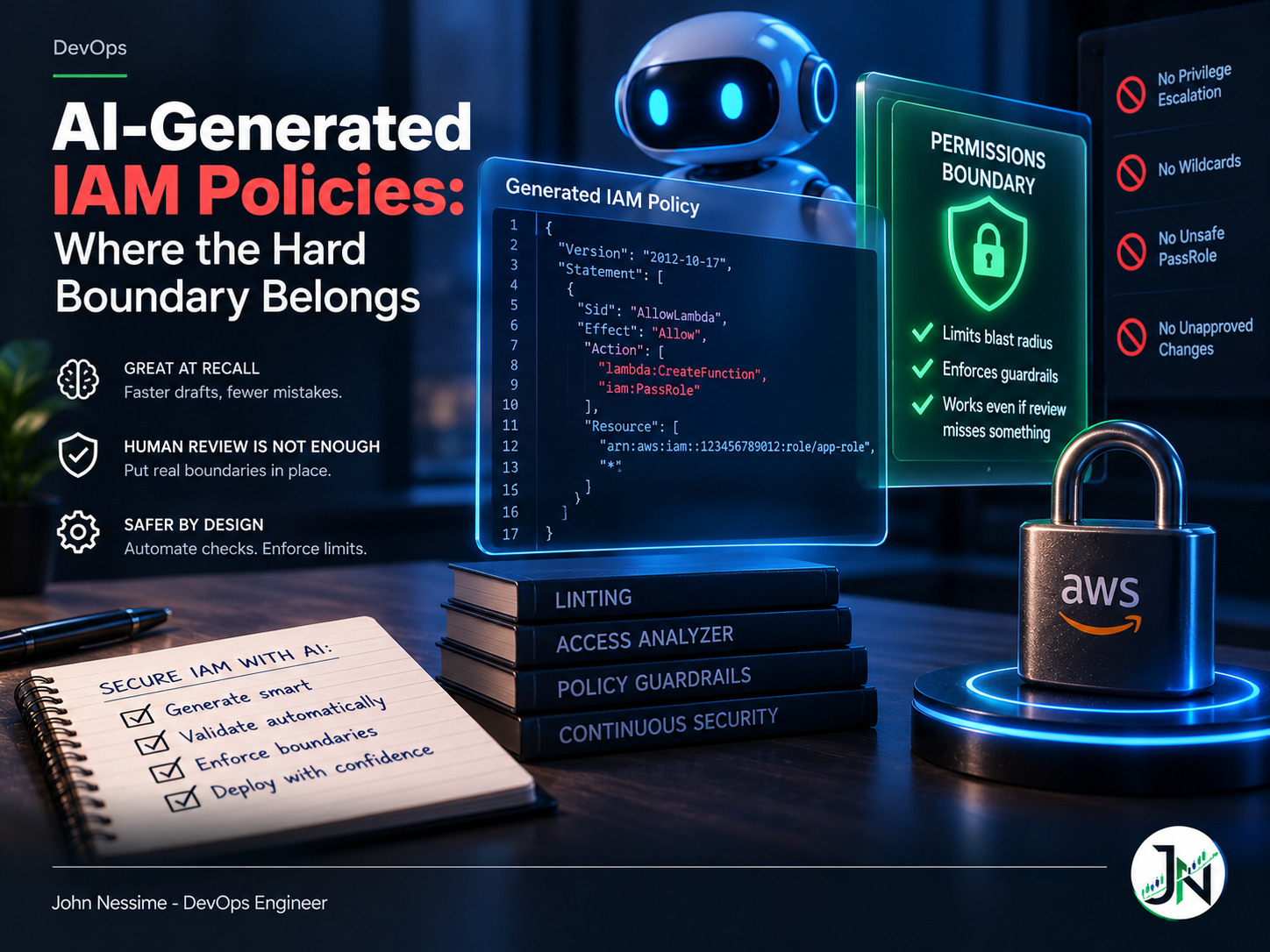
It granted iam:PassRole on one role ARN and lambda:CreateFunction in the same document. That is not a wildcard and it does not read as administrative access. It is administrative access anyway, to whatever that role can do, for anyone who can write a Lambda function.
This is the shape of the problem with AI-generated IAM policies. The failure is almost never the obvious one. Models have absorbed enough style guidance to avoid "Action": "*", so what comes back passes the eyeball test and the linter and still hands over more than you meant to give. The dangerous output is the one that looks careful.
This post covers what policy generation genuinely does well, the failure shapes that survive human review, and where the hard boundary belongs: not in the review step, which is fallible, but in a mechanism that cannot be talked out of its answer.
What AI-generated IAM policies get right
Start with the honest case, because it is a strong one. IAM has thousands of actions across hundreds of services and the naming is inconsistent in ways nobody holds in their head. Some services use Describe, some use Get, some use both for different things. ARN formats vary per service and per resource type inside a service. Condition keys apply to some actions and not others.
A model is good at that recall problem, and at shape work: splitting a monolithic statement into per-resource statements, adding conditions, converting an inline policy into Terraform. Paste an AccessDenied message and you get a plausible read of which layer refused. So the argument is not that the tooling is useless. It is that recall and reasoning about consequences are different capabilities, and IAM is a system where the second one protects you.
The failure modes that survive review
Permissions that compose into something bigger
Every action is individually defensible. The escalation lives in the combination.
The canonical case is iam:PassRole beside any service that runs code: Lambda, EC2, ECS, Glue. Passing a role to a compute service means your code executes with that role’s permissions, so your ceiling is not your own policy, it is whatever the most powerful passable role can do. Rhino Security Labs catalogued a long list of these chains and every one of them is built from permissions that look unremarkable alone.
Another that catches people: iam:CreatePolicyVersion on a policy you are attached to. A new version normally needs to be set as default to take effect, but the create call accepts a flag that makes it default immediately, and that flag does not require iam:SetDefaultPolicyVersion. A permission that reads as “can update policy documents” reads to an attacker as “can write myself an admin policy.”
Ask a model whether a policy grants admin and it will check the statements and say no, correctly, one at a time. Composition is the part it does not reliably do, and it is the part that matters.
Actions that do not exist
Plausible action names that no service publishes. s3:ListBucketContents instead of s3:ListBucket. IAM accepts a policy containing an unrecognized action string because the document is syntactically valid, so nothing fails at attach time.
What happens instead is worse. The application throws AccessDenied in production, somebody debugging under pressure decides the granular list must be wrong, and the fix is a service wildcard. The invented action does not grant too much. It causes a human to grant too much a week later, and by then nobody connects the two events.
Resource ARNs that look constrained and are not
An ARN with real characters in it feels safer than a star. Often it is not. The common versions are a trailing wildcard placed one segment too high, and an action whose resource element the service ignores. s3:ListAllMyBuckets is account-scoped no matter what you put in Resource. Several ec2:Describe actions behave the same way. A policy can read as resource-scoped throughout and be account-wide for the actions that count.
The related trap is the missing condition: cross-account trust policies without an external ID, bucket policies without aws:PrincipalOrgID, integration roles without aws:SourceIp where the caller has a stable egress address. Generated policies include conditions when you ask and omit them when you do not, because an absent constraint never produces an error.
Four things the model cannot know
Some of this is not a capability gap you can prompt past. It is missing input:
- Which resources exist. A bucket name is a guess unless you supplied it. Guessed names either fail closed or, if the wildcard is loose enough, match something you never intended.
- Which resources are sensitive. Your backup bucket and your public assets bucket are indistinguishable strings. Sensitivity lives nowhere in the document.
- What else is attached. Effective permissions come from identity policies, resource policies, boundaries, SCPs and session policies together. Reviewing one document tells you very little.
- What the blast radius is. “Can delete objects” means one thing for a scratch bucket and another for the only copy of a client’s data.
The training material is also skewed. Public IAM examples, including plenty of vendor documentation and countless forum answers, are permissive because permissive examples work on the first try. A model that has read the internet has read a lot of over-broad policies presented as correct.
Where the hard boundary belongs
Review is not a boundary. Review is a filter with a pass rate that drops the more policies you look at in a week, and generated policies are cheap to produce, so volume rises exactly when attention falls.
The boundary has to be something that says no without reading the document. AWS gives you two mechanisms and they are not interchangeable.
A permissions boundary is a managed policy attached to a user or role that caps what identity-based policies can grant it. It grants nothing itself. Effective permissions become the intersection of the identity policy and the boundary, so an identity policy allowing iam:* against a boundary that omits IAM produces no IAM access at all. If no boundary is attached, none is evaluated, so this is opt-in per identity.
A service control policy sets the maximum available permissions for every principal in an account or organizational unit, and also grants nothing. It is the right home for things nobody in that account should ever do, and it applies whether or not somebody remembered to attach a boundary.
The division I use: SCPs carry account-wide invariants, such as denying escalation-relevant IAM write actions to everyone outside the break-glass role and denying regions you do not operate in. Boundaries carry the per-workload ceiling, and they are what makes it safe to let a pipeline role create other roles. You can permit that role to create roles while requiring, through a condition on the boundary key, that every role it creates carries your boundary. The pipeline can then generate whatever policy it likes, because the ceiling is enforced at evaluation time rather than at review time.
If the only thing between a generated policy and production is a person reading JSON, you do not have a boundary. You have a habit.
The gate I would actually run
Mechanical checks in a pipeline, failing the build, not a checklist somebody is supposed to remember.
- Lint for nonsense. Parliament catches unknown action names, resource formats that cannot match the action, and type mismatches. Cheapest way to catch an invented action before it becomes a wildcard.
- Run AWS policy validation. Access Analyzer knows service-specific rules a generic linter does not.
- Assert the escalation actions are absent. Name the actions you never want granted and fail if any appear. This is the check that maps to the composition failure.
- Compare against the current policy. For edits, check whether the proposed document grants access the existing one does not. This one is billed per call, so run it on changed policies rather than the whole repository.
- Scan for known risky patterns. Cloudsplaining scores policies against categories including privilege escalation, data exfiltration and resource exposure, and produces something you can hand to a client.
# 1. Lint. Exit status is non-zero when there are findings.
parliament --file policy.json

# 2. AWS-side validation
aws accessanalyzer validate-policy
  --policy-document file://policy.json
  --policy-type IDENTITY_POLICY

# 3. Fail if any escalation-relevant action is granted
aws accessanalyzer check-access-not-granted
  --policy-document file://policy.json
  --access actions="iam:PassRole","iam:CreatePolicyVersion","iam:AttachRolePolicy"
  --policy-type IDENTITY_POLICY

# 4. Does the proposed policy grant more than the current one?
aws accessanalyzer check-no-new-access
  --existing-policy-document file://current.json
  --new-policy-document file://proposed.json
  --policy-type IDENTITY_POLICY

# 5. Risk-categorised report
cloudsplaining scan-policy-file --input-file policy.json
Step three is the one to add first if you only add one. It turns “we reviewed it” into “the build fails.”
Attaching the boundary is a single call, and it is the part people skip because the role already works without it:
aws iam put-role-permissions-boundary
  --role-name app-deploy-role
  --permissions-boundary arn:aws:iam::123456789012:policy/WorkloadCeiling
Generate from observed behavior instead
There is a better source of truth than a model’s guess about what an application needs, and it is the application. Access Analyzer policy generation reads CloudTrail events for a role over a chosen window and writes a policy from what was actually called. Know its limits before relying on it:
- It analyzes up to ninety days of history and needs a trail already logging for the account, so a role that only exercises certain paths quarterly produces an incomplete policy.
- Coverage is per-service. For some services it identifies individual actions; for others it can only tell you the service was used and prompts you to fill in the actions yourself.
- It does not produce action-level detail for data events such as S3 object-level operations.
iam:PassRoleis not included in generated policies. If your workload needs it, a human adds it back by hand, so the most escalation-relevant line in the document is the one the generator did not write.
Behavior-derived policies also fail in a useful direction. A missing permission produces a denial you can see in CloudTrail, which beats a permission you did not know you granted.
Arguments that do not survive contact
- “We review every policy before merge.” Review quality is a function of volume and attention, and generation raises volume. Composition failures are also the hardest to spot by reading, because spotting them means knowing what other roles exist and what they can do.
- “Access Analyzer came back clean.” Validation checks the document. It does not know that the role ARN you may pass happens to have
AdministratorAccessattached. Clean findings on a policy that grants a dangerous chain is the normal case, not an anomaly. - “A permissions boundary is overkill for a small project.” Small projects are where this bites hardest. One account, one deploy role, no organization, nothing between a bad policy and everything you own. The boundary is one managed policy and one CLI call.
- “We will tighten it after launch.” Nobody does. If you genuinely intend to, drive it from Access Analyzer’s unused access findings so you have a work queue instead of an intention.
- “Just prompt the model to follow least privilege.” That changes the output surface, not the reasoning. Fewer wildcards, better statements, no evaluation of what the combination permits.
How I would decide
My rule is about which actions are in the document, not about who or what wrote it.
Ship generated policies freely when the document touches only data-plane actions on named resources, the identity has a boundary, and the pipeline checks pass. Read a bucket prefix, publish to a topic, write to a table. That is most policies, and hand-writing them wastes your afternoon.
Treat generated output as a first draft when the policy includes any IAM write action, any PassRole, any trust policy edit, any resource policy readable from outside the account, or any KMS key policy. Use it to save typing, then verify every statement against the service authorization reference yourself.
Do not generate at all for the boundary policies and SCPs. Those are the mechanism. Something that constrains everything else should be short, hand-written, understood by whoever owns the account, and changed rarely.
Two notes for small engagements. If you run application infrastructure on a VPS from a provider like Contabo or InterServer and pull AWS in for storage or mail, that server holds long-lived credentials somewhere your AWS controls do not reach, so scope its policy to a bucket prefix and attach a boundary before worrying about anything else. And if the credentials go to a SaaS connector, a marketing platform such as GoHighLevel or a payments integration, you are handing keys to a system whose behavior you cannot audit. Those are the policies to write by hand.
Frequently asked questions
Are AI-generated IAM policies safe to use in production?
For data-plane permissions on named resources, generally yes, provided the identity carries a permissions boundary and the policy passes automated validation. For anything involving IAM write actions, PassRole, trust policies or key policies, treat the output as a draft and verify each statement yourself. What matters is the blast radius of the actions, not the authorship.
Why does a generated policy pass validation and still grant too much?
Validation examines one document in isolation. Privilege escalation usually comes from a combination of individually reasonable permissions, or from the interaction between the policy and something outside it, such as which roles are passable and what those roles can do. A document can be internally correct and still open a path.
What is the difference between a permissions boundary and an SCP?
Both cap permissions and neither grants any. A boundary attaches to a single IAM user or role and limits what that identity’s policies can grant it. An SCP applies to every principal in an account or organizational unit and needs AWS Organizations. With one account and no organization, boundaries are what you have. With an organization, use both.
Can IAM Access Analyzer replace writing policies by hand?
Partly. Generation from CloudTrail activity beats a guess because it reflects what the workload actually called. It is limited by the analysis window, by per-service coverage differences, by the absence of action-level detail for data events, and by iam:PassRole being excluded. Treat it as a strong draft that needs a human pass over anything the generator could not see.
Which IAM actions should I block outright in a small account?
The ones that let a principal rewrite its own permissions or borrow another identity’s: creating and setting default policy versions, attaching and putting inline policies on users, roles and groups, creating access keys for other users, and passing roles to compute services. Deny them for everything except a break-glass identity, then grant them back deliberately where a workload genuinely needs one.
How do I catch an invented action name before production?
Run a linter that carries the IAM action catalogue. Parliament flags unknown actions and exits non-zero when it finds anything, so it drops straight into a pipeline step. Catching it early matters less because the fake action is dangerous and more because the eventual fix for the denial tends to be a service-level wildcard.
The one thing worth remembering
AI-generated IAM policies are not more dangerous because a model wrote them. They are more dangerous because they arrive faster than you can think about them, and because they arrive looking finished.
So stop trying to make the review step better. Put the boundary somewhere that does not depend on anyone paying attention: a permissions boundary on every identity a pipeline can create or modify, an SCP denying the escalation actions to everyone who does not need them, and a build step that fails when a forbidden action shows up. Then let generation happen at whatever speed it wants.
The policy approved in ninety seconds is not the failure. The absence of anything underneath it was.
Need help drawing that boundary in your account?
Most of the IAM work I take on is exactly this: an account that grew organically, permissions nobody wants to touch in case something breaks, and no ceiling underneath any of it. Things I can help with:
- Auditing existing roles and policies for privilege escalation chains, including the passable-role paths that never show up in a single-document review
- Designing and attaching permissions boundaries for pipeline, workload and human identities, including the delegation pattern that lets a deploy role create roles safely
- Writing the SCP set for a small organization: escalation-relevant IAM actions, region restrictions, and protection for logging and billing resources
- Adding Access Analyzer validation and custom policy checks to a CI pipeline so forbidden actions fail the build instead of relying on review
- Replacing over-broad roles with policies generated from CloudTrail activity, then closing the gaps the generator cannot see
- Scoping down credentials handed to third-party SaaS integrations and to servers outside AWS, where your account controls do not apply
If you want a second opinion on something specific, send me the policy JSON, the output of a failing check-access-not-granted run, or the role list from your account, and I will tell you what I would change and why.