The CX lead pings you on a Thursday afternoon: “Sentiment has been sitting at 3.2 for four months. Is the pipeline broken?”
You check. Every extraction job ran. Every ticket got a label. No rows dropped, no schema drift, no dead letters. Nothing is broken. The number is just useless, and it has been useless since the day it shipped.
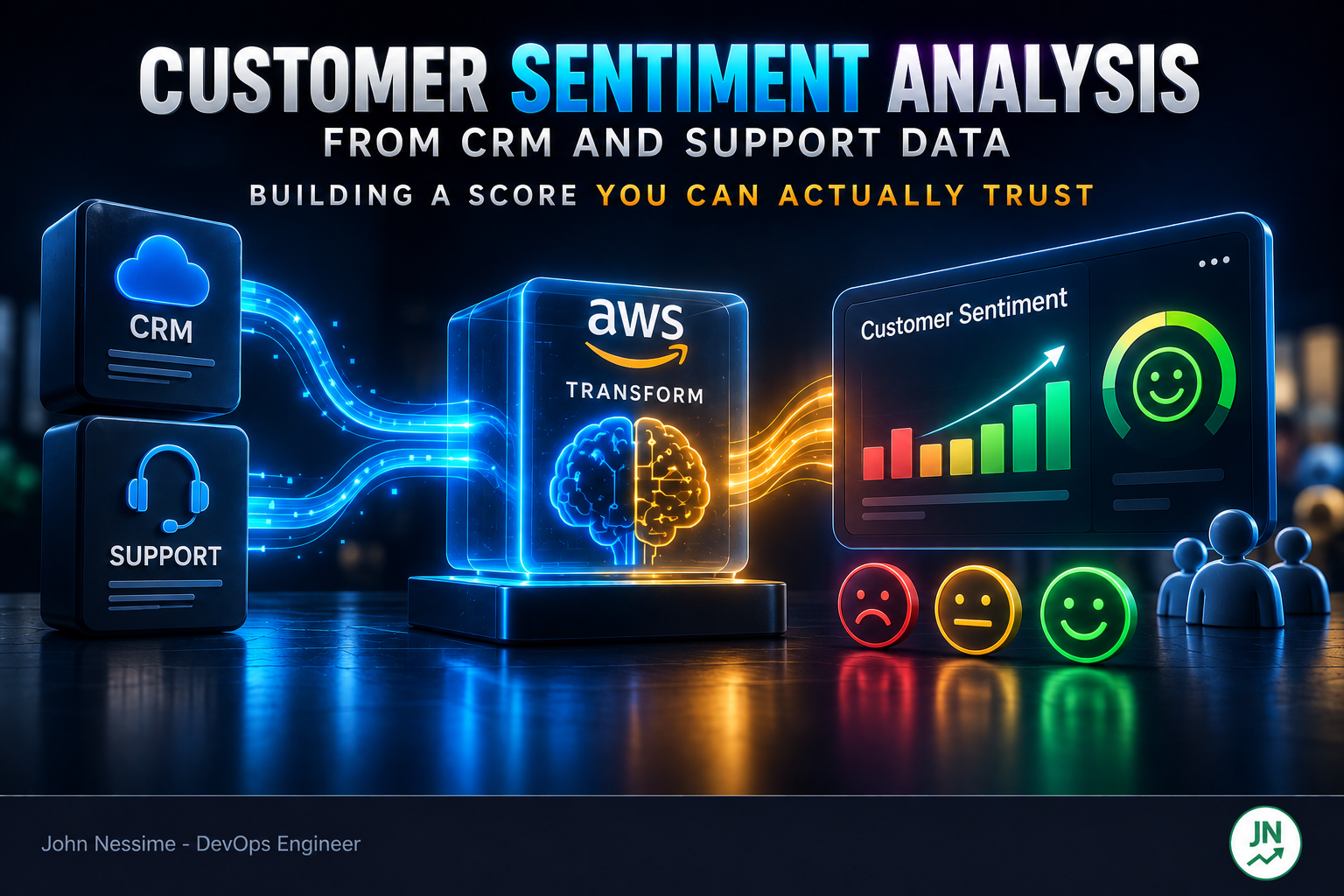
That is the normal outcome for customer sentiment analysis built on CRM and support data. The connectors work, the model returns labels, the dashboard renders on schedule, and the output still cannot tell anyone whether customers are getting happier or angrier. These are not pipeline failures. They are measurement failures, which is exactly why your monitoring never catches them.
This post walks through the failure families I check first when a sentiment programme is producing numbers nobody trusts: where the label gets stamped, what happens when you average an ordinal scale, who is missing from the data entirely, why a general-purpose model misreads support English, where the CRM join breaks, and one regulatory boundary that catches more teams than it should. Then a pipeline shape that holds up, and the checks worth running before anyone puts this on a slide.
What the score is actually measuring
Before anything else, get specific about the unit of analysis. “Customer sentiment” is a phrase people use for at least four different measurements:
- Message sentiment — the tone of one comment in one thread.
- Ticket sentiment — usually the first inbound message, sometimes a rollup.
- Contact sentiment — one human’s tone across all their tickets.
- Account sentiment — the thing the business actually cares about, and the one nobody computes correctly.
Most stacks compute the second and label it the fourth. That single substitution causes more bad decisions than any model choice you will make downstream. A model with mediocre accuracy applied at the right unit beats an excellent model applied at the wrong one.
Failure one: the label is stamped at the wrong moment
This is the expensive one, and it is invisible from the pipeline side because nothing errors.
Zendesk’s intelligent triage is the clearest example because the documentation is honest about it. Zendesk states that most intelligent triage classifications are based on a ticket’s first message only, with an admin-configurable option to update topic and sentiment from the latest end-user message. If nobody turned that option on, your “customer sentiment” field is a permanent record of how annoyed someone was in their opening paragraph.
Think about what that does to a trend line. The opening message of a support ticket is negative almost by definition, because people do not open tickets to say things are going well. What you want to know is whether the interaction ended well. A ticket that opens furious and closes with a thank-you is a support win, and a first-message-only score records it as a loss forever.
Two consequences follow that people miss:
- Your sentiment metric is structurally incapable of moving in response to anything the support team does. Hire better agents, cut response time in half, rewrite your macros: the number will not budge, because it was set before any of that happened.
- It will move in response to marketing, onboarding and product changes upstream, because those change who opens tickets and how angry they are on arrival. So the metric drifts for reasons the team watching it cannot influence.
Zendesk also documents that when an agent corrects the sentiment field on a ticket, the correction does not retrain the model. Worth knowing before you build a human-review workflow on the assumption that it feeds back into anything. It gives you a cleaner column, not a better classifier.
The fix is to decide your stamping policy explicitly and store it. Score the first inbound message, score the last inbound message, and store both, along with the delta. The delta is the interesting column. Sentiment recovery within a thread is a far better signal of support quality than absolute sentiment ever was.
Failure two: averaging a scale that was never numeric
Zendesk exposes sentiment as five ordered values from Very negative to Very positive, and Zendesk Explore ships a prebuilt report for average customer sentiment on a one-to-five scale. Amazon Comprehend returns one of POSITIVE, NEGATIVE, NEUTRAL or MIXED plus per-class confidence scores. Google Cloud Natural Language returns a polarity score and a magnitude. Azure AI Language returns document- and sentence-level labels with confidences.
Only some of those are numbers, and none of the label sets are interval scales. The gap between Very negative and Negative is not the same size as the gap between Neutral and Positive, and there is no defensible reason to assume it is. So when you compute AVG(sentiment), you are doing arithmetic on rank labels and getting a value that has no units.
That would be a pedantic complaint if it were only a purity issue. It is not, because support sentiment distributions are usually bimodal. People write in angry or they write in grateful. Very few tickets are genuinely neutral. Take the mean of a two-humped distribution and you land in the valley between the humps, in a bucket where almost nobody actually is. Worse, the mean is stable there: the humps can grow, shrink and swap size while the average barely moves. That is your flat 3.2.
Use share metrics instead. They are ordinal-safe, they move, and they are directly actionable.
-- Share of negative tickets, weighted by account value.
-- Ordinal-safe: no arithmetic on the label itself, only counting.
SELECT
    date_trunc('week', t.created_at)                      AS week,
    COUNT(*)                                              AS tickets,
    COUNT(*) FILTER (
        WHERE t.sentiment IN ('very_negative', 'negative')
    )                                                     AS negative_tickets,
    ROUND(
        100.0 * COUNT(*) FILTER (
            WHERE t.sentiment IN ('very_negative', 'negative')
        ) / NULLIF(COUNT(*), 0)
    , 1)                                                  AS pct_negative,
    SUM(a.arr) FILTER (
        WHERE t.sentiment IN ('very_negative', 'negative')
    )                                                     AS arr_behind_negative
FROM   support_tickets  t
JOIN   crm_contacts     c ON c.id = t.contact_id
JOIN   crm_accounts     a ON a.id = c.account_id
WHERE  t.created_at >= date_trunc('week', CURRENT_DATE) - INTERVAL '26 weeks'
GROUP  BY 1
ORDER  BY 1;
Three things are happening there worth calling out. FILTER counts rows in a category without touching the label as a number. NULLIF stops a zero-ticket week from throwing a division error and silently killing the job. And the last column is the one executives will actually read, because a percentage of tickets is a support metric while revenue sitting behind negative sentiment is a business metric.
Failure three: the people who left never showed up in the data
Support data only contains customers who chose to contact you. That is a selection effect, not a sample.
The dangerous version is this: negative sentiment falls, everyone celebrates, and the actual cause is that the angriest cohort stopped writing in because they had already decided to leave. Silence reads as improvement. In a quarter where churn is rising, a falling negative-sentiment share is a warning sign, not a win.
You cannot fix this inside the support dataset, which is precisely why the CRM join matters. Two guards worth building:
- Contact rate as a companion metric. Tickets per active account per month, tracked alongside sentiment. Sentiment improving while contact rate collapses is a disengagement pattern, not a satisfaction one.
- Went-quiet detection. Accounts that used to file tickets regularly and have filed none in a defined window. In most books of business this list is a better churn predictor than the sentiment score itself, and it costs one window function to produce.
Failure four: the model learned someone else’s language
General-purpose sentiment APIs are trained largely on review-style and social text. Support English is a different dialect, and the mismatches are systematic rather than random.
- Problem statements are not complaints. “The export fails with a 500” is a factual bug report. Review-trained models frequently score it negative because failure vocabulary dominates.
- Politeness masks severity. A calmly worded message from an enterprise admin saying the production sync has been down since Tuesday is your worst ticket of the week and will score close to neutral.
- Domain vocabulary inverts. “Killed the process”, “the job died”, “aborted the run” are neutral technical descriptions carrying heavy negative weight in general corpora.
- Your own text pollutes the corpus. Auto-acknowledgements, signatures, quoted reply chains and CSAT survey footers all get scored if you feed the raw comment body. Quoted history is the big one: score a five-reply thread naively and you have scored message one five times.
- Non-native English reads flat. Simpler sentence structure and less emotional vocabulary push scores toward neutral for a whole segment of your customer base, which quietly biases any regional comparison.
Independent evaluations of the major cloud sentiment APIs on general text tend to land well below the accuracy figures in vendor marketing, and the providers frequently disagree with each other on the same input. Treat published benchmark numbers as irrelevant to your decision. The only number that matters is accuracy on a few hundred of your own tickets, hand-labelled by someone who understands your product.
Building the evaluation set
- Pull a stratified random sample of tickets: across channels, across regions, across account tiers. Do not sample only recent tickets, or you bake in whatever was happening that month.
- Have two people label independently, using a written rubric with worked examples of each class.
- Measure agreement between the humans first. If your two support leads disagree on a third of the tickets, the task is underspecified and no model will fix that. Tighten the rubric and relabel.
- Only then score the candidate models against the human labels, and look at the confusion matrix rather than accuracy. Where a model confuses classes tells you whether it is usable.
- Freeze that set. It becomes your regression test when a vendor silently updates a model version.
Step three is the one teams skip, and it is the one that saves the project. Human agreement is the ceiling on model performance. There is no point chasing 90% against labels your own experts only agree on 70% of the time.
Failure five: the CRM join is where the value and the breakage both live
A sentiment label with no account attached is trivia. Two hundred irritated free-tier users and one irritated account paying for a third of your renewals are not the same event, and the raw ticket table cannot tell them apart.
The join from helpdesk to CRM is almost always on email, and email is a terrible key. Expect all of this:
- Shared inboxes such as ops@ or billing@, mapping to no single contact or to several.
- Personal addresses used by people who work at a customer, invisible to any domain-matching logic.
- Contacts who left and were deleted in Salesforce, HubSpot or Zoho CRM, orphaning every historical ticket they filed.
- Account hierarchies, where the subsidiary files the ticket and the parent holds the contract.
- Mergers and renames, which quietly rewrite history if your warehouse dimension is not versioned.
The engineering answer is boring and effective: treat unmatched tickets as a first-class, monitored quantity rather than something the join silently discards. Track match rate as a data quality metric with an alert threshold. When it drops, something changed in the CRM, and you want to know that before the number on the dashboard shifts for a reason nobody can explain.
Also version the account dimension. If you overwrite the tier or the ARR in place, then every historical aggregate silently rewrites itself the next time someone upgrades, and last quarter’s report stops reproducing.
The legal boundary that catches sentiment projects
This one is worth reading carefully if you have EU customers or EU staff, because the line does not fall where most people assume, and a lot of contact-centre software sells both sides of it in one bundle.
Article 5(1)(f) of the EU AI Act prohibits AI systems that infer emotions of a person in the workplace or in education settings. The prohibitions in Article 5 have applied since 2 February 2025, and breaches sit in the Act’s highest penalty band. What matters for a sentiment project is the scope, which is narrow on two axes at once:
- It applies to emotion inference from biometric data — faces, voiceprints, physiological signals. The European Commission’s guidance takes the position that inferring emotion from written text is not based on biometric data and therefore falls outside the prohibition.
- It applies to workplace and education contexts. Your customers writing into a helpdesk are neither.
So scoring the text of customer tickets and CRM notes generally sits outside the ban. Running voice-based emotion or stress analysis on your own support agents’ calls, for coaching or quality scoring, is the case the prohibition was written for. Plenty of platforms ship customer-facing text sentiment and agent-facing voice sentiment as adjacent features in the same product, and the pitch does not distinguish them. If you are the deployer, the compliance obligation is yours, and a vendor’s assurance is not a defence.
Separately, Article 50 carries transparency obligations for emotion recognition systems where they remain lawful. And none of this displaces GDPR: ticket bodies are full of personal data, and shipping them to a third-party API is a processing decision that needs a basis, a processor agreement and a residency answer.
I am an engineer, not a lawyer. Treat the above as the shape of the question to take to counsel, not as advice.
A pipeline shape that survives contact
Nothing exotic. The discipline is in what you store, not what you call.
- Extract incrementally from the helpdesk and CRM on an updated-at cursor, not a full reload. Land raw payloads immutably before you transform anything, so a bad model run is re-runnable without re-hitting the source API.
- Clean the text. Strip quoted reply chains, signatures, automated acknowledgements and survey footers. Keep the cleaned text as its own column so a scoring bug is debuggable later.
- Redact personal data before it leaves your boundary. Regex handles the structured patterns: emails, phone numbers, card and account numbers, order IDs. Named-entity detection handles names and addresses. Amazon Comprehend exposes
DetectPiiEntitiesandContainsPiiEntitiesfor this if you are already in AWS. - Score in batches, with the model identifier and version written into every row.
- Aggregate at account level with share metrics and value weighting, against a versioned account dimension.
- Alert on movement, not on level. Nobody acts on “sentiment is 3.2”. People act on “this named account’s negative share tripled in two weeks”.
Step four’s version column is the one people leave out and regret. Managed sentiment endpoints get retrained. When labels shift on unchanged text, the version column is the difference between a five-minute explanation and a week of forensics.
Here is what a batch call looks like against Amazon Comprehend, which is a reasonable default if your warehouse already lives in AWS:
import boto3

comprehend = boto3.client("comprehend", region_name="eu-west-1")

# BatchDetectSentiment accepts a maximum of 25 documents per call,
# and DetectSentiment caps each document at 5 KB of UTF-8 text.
# Chunk to both limits or the call fails for the whole batch.
BATCH_SIZE = 25
MAX_BYTES  = 5000

def score_batch(texts):
    payload = [t.encode("utf-8")[:MAX_BYTES].decode("utf-8", "ignore")
               for t in texts[:BATCH_SIZE]]
    resp = comprehend.batch_detect_sentiment(
        TextList=payload,
        LanguageCode="en",
    )
    # ResultList is index-aligned to the input; ErrorList holds
    # per-document failures. Read both or you lose rows silently.
    return resp["ResultList"], resp["ErrorList"]
The truncation on the encoded bytes rather than the character count is deliberate: the limit is measured in bytes, and a ticket full of accented characters or CJK text hits it much earlier than the character count suggests. The ErrorList read matters for the same reason a dead letter queue matters. A partial batch success that you never inspect is data loss that looks like a clean run.
For a quick sanity check on a single string before wiring any of this up, the CLI is faster than writing code:
aws comprehend detect-sentiment
    --region eu-west-1
    --language-code "en"
    --text "Still waiting on the refund you promised last week."

{
    "SentimentScore": {
        "Mixed": 0.0033542951568961143,
        "Positive": 0.0086313202530145600,
        "Neutral": 0.1495875907897949,
        "Negative": 0.8384268
    },
    "Sentiment": "NEGATIVE",
    "LanguageCode": "en"
}
Note that the response carries per-class confidences, not just the winning label. Store the whole SentimentScore object. A ticket scored NEGATIVE at 0.51 and one scored NEGATIVE at 0.98 are very different tickets, and the label alone throws that away. Confidence is also what lets you route only the ambiguous cases to a more expensive model or a human, instead of paying for everything.
Choosing where the model runs
Three broad options, and the trade-offs are real in both directions.
- Native helpdesk features. Zendesk intelligent triage, Salesforce Einstein, HubSpot and Zoho CRM all ship some form of built-in sentiment. Zero integration work, labels land on the ticket where agents can see them, and routing rules can consume them directly. You get the vendor’s definition of sentiment, no control over stamping policy beyond the toggles they expose, and data that is awkward to move.
- Managed NLP APIs. Amazon Comprehend, Azure AI Language and Google Cloud Natural Language. Per-character billing, no infrastructure, useful extras such as aspect-level or targeted sentiment. Comprehend’s targeted sentiment, which attaches sentiment to specific entities in the text, is English-only, and that constraint bites hard if your support volume is multilingual. Bill by volume of text, so a batch backfill of five years of tickets is a genuinely different cost event from steady-state scoring.
- Self-hosted transformers. A fine-tuned encoder model from the Hugging Face ecosystem, running on your own box. Best accuracy on your domain once tuned, no per-call cost, no text leaving your perimeter, which resolves most residency arguments before they start. In exchange you own model serving, evaluation and drift. A mid-tier dedicated server from a provider like Contabo or Hetzner runs CPU inference for batch workloads perfectly well, and batch is what this workload is. You do not need a GPU to score yesterday’s tickets overnight.
If you have no strong residency constraint and a small volume, start with a managed API. The self-hosted path is worth it when you have enough labelled data to fine-tune, or a legal reason the text cannot leave. Not before.
Troubleshooting
Sentiment is flat regardless of what the team does
Two likely causes. Either you are averaging an ordinal scale over a bimodal distribution, or you are scoring first messages only. Check the distribution shape first, since it takes one query. If it has two humps, switch to share metrics before you touch anything else.
Everything scores neutral
Usually a text-cleaning problem. If quoted reply chains, signatures and boilerplate survive into the scored text, the actual message is diluted by noise and the model regresses to neutral. Print the exact string you are sending for twenty tickets and read them. This bug is invisible in aggregate and obvious in the raw payload.
The trend shifted overnight with no matching business event
Check the model version column and the CRM match rate on the same day. A managed endpoint retrain and a CRM field change both produce exactly this signature. If you did not store the version, this is the moment you start.
One region always looks happier
Before concluding anything about that region, check the language distribution. Non-native English and machine-translated tickets both drift toward neutral, which shows up as “less negative” in a share metric. Compare like with like by language, or score in the original language where the provider supports it.
Batch scoring jobs fail intermittently
Almost always the document size limit, hit by one oversized ticket with a pasted log file or stack trace in the body. Truncate on encoded byte length before the call and check the per-document error list rather than assuming a successful HTTP response means every document scored.
Common mistakes
- Reporting an average of an ordinal label set and calling it a score.
- Scoring the first message and describing the result as customer satisfaction.
- Treating unmatched tickets as an inner-join casualty instead of a monitored metric.
- Sending raw ticket bodies to a third-party API with no redaction step.
- Discarding confidence scores and keeping only the winning label.
- Trusting a vendor accuracy figure over a few hundred of your own hand-labelled tickets.
- Overwriting the account dimension in place, so historical reports quietly stop reproducing.
- Assuming a helpdesk vendor’s compliance posture transfers to you as the deployer.
Best practices for customer sentiment analysis
- Write down the unit of analysis before writing any code, and make sure the dashboard label matches it.
- Store first-message sentiment, last-message sentiment and the delta. Report the delta.
- Use share-of-negative and value-weighted share, never a mean over labels.
- Keep a frozen, hand-labelled evaluation set and re-run it on a schedule as a regression test.
- Persist the model identifier, model version and full confidence distribution on every scored row.
- Redact personal data before the text crosses a network boundary, and log what was redacted, not the values.
- Monitor CRM match rate, contact rate and language mix alongside the sentiment number itself.
- Alert on named-account movement, not on the global level.
- Know which side of the biometric line each feature you enable sits on, and put the answer in writing.
Frequently asked questions
Is customer sentiment analysis accurate enough to act on?
For prioritisation and trend detection, generally yes. For individual decisions about a specific customer, no. The reliable pattern is to use it as a filter that surfaces conversations for a human to read, rather than as a verdict. Any single ticket’s label should be treated as a hint, not a fact.
Should I use my helpdesk’s built-in sentiment or build my own pipeline?
Start with the built-in feature. It is free or cheap, it lands where agents work, and it tells you within a month whether anyone actually uses sentiment for anything. Build your own when you need a different stamping policy, cross-system aggregation, account-value weighting, or control over where the text is processed. Those are the four reasons that justify the effort.
Can I use an LLM instead of a dedicated sentiment API?
You can, and the quality on nuance, sarcasm and domain vocabulary is usually better because you can describe your product and your customers in the prompt. The costs are latency, price per token at backfill scale, and output stability. Pin the model version, constrain the output to a fixed label set, and set temperature to zero, or you will get labels that drift between runs on identical text. A pragmatic middle ground is a cheap classifier by default with an LLM as a fallback on low-confidence cases.
How much historical data do I need before the trend means anything?
Enough to cover your seasonality, which for most businesses means at least a full year. Support volume and tone move with billing cycles, product releases, holidays and renewal periods. A quarter of data will show you a trend that is really just the calendar.
Does sentiment analysis on support tickets fall under the EU AI Act ban?
The Article 5(1)(f) prohibition targets emotion inference from biometric data in workplace and education contexts, and Commission guidance treats text-based sentiment as outside that scope. Scoring customer-written text is generally not caught. Voice or facial emotion analysis applied to your own employees is squarely the thing it prohibits. Transparency duties and GDPR obligations still apply regardless, and this is a question for your counsel rather than your engineer.
What is a good target for share of negative tickets?
There is no cross-industry benchmark worth quoting, because the number depends entirely on your product category, your support channels and how the model was calibrated. Your own baseline is the only meaningful comparison. Measure for a full cycle, then set targets against that.
How do I handle multilingual support volume?
Detect the language, store it as a column, and segment every report by it. Do not translate to English and then score, since translation flattens emotional register and adds a second error source. Check which of your provider’s features are English-only before designing around them; some advanced modes, including Comprehend’s targeted sentiment, are narrower than the base sentiment endpoint.
The one thing worth remembering
A customer sentiment analysis pipeline that runs cleanly every night and produces a number nobody can act on is not a partially working system. It is a broken one, and the breakage is upstream of anything your monitoring can see.
So before optimising a model or shopping for a platform, answer three questions in writing: which message gets scored, what unit the number describes, and which accounts it is weighted by. Get those right with a mediocre classifier and you have something useful. Get them wrong with the best model on the market and you have a very accurate description of how annoyed people were in their opening sentence.
Need help making this work on your data?
I build and fix the data plumbing behind customer analytics. On this particular problem, that usually means:
- Auditing an existing sentiment metric to find out why it never moves, and rebuilding it on share and delta metrics that do.
- Building incremental extraction from Zendesk, Salesforce, HubSpot or Zoho CRM into a warehouse, with cursor state, retries and dead-letter handling that survives an API outage.
- Fixing the helpdesk-to-CRM identity join, including shared inboxes, account hierarchies and a versioned account dimension so historical reports keep reproducing.
- Standing up a redaction layer so ticket text is scrubbed of personal data before it reaches any third-party model endpoint.
- Running a proper evaluation: stratified sample, dual human labelling, inter-rater agreement, confusion matrices across candidate models, and a frozen regression set.
- Setting up account-level alerting in Grafana or your BI tool that fires on movement in named accounts rather than on a global average.
If you have a dashboard that has been flat for months, send me the query behind it and a screenshot of the distribution. That is usually enough to tell you what is wrong before we talk about scope.