Read more about the article Your WordPress 403 Isn’t the Rule You Think: Tuning ModSecurity False Positives
A WordPress 403 error isn't always caused by a malicious request. ModSecurity false positives can block legitimate updates. Inspect anomaly scores and tune specific WAF rules without weakening site security.

Your WordPress 403 Isn’t the Rule You Think: Tuning ModSecurity False Positives

A 403 from ModSecurity almost never names the rule you need to change. Under anomaly scoring, detection rules only add to a score and a separate blocking rule returns the error. This guide covers reading the audit log backwards, choosing between the four exclusion mechanisms, the WordPress failure families that cause most false positives, and why raising the anomaly threshold quietly destroys your coverage.

Continue ReadingYour WordPress 403 Isn’t the Rule You Think: Tuning ModSecurity False Positives

Low Free Memory on Linux Isn’t a Problem. Here’s What Actually Is.

A screenshot of free -h showing 200 MB free triggers more unnecessary change requests than almost any other output in server operations. Here is what the free command is really reporting, why the available column is the one that matters, and the four signals that actually tell you a machine is running out of memory: available, swap rate, pressure stall information and the OOM log.

Continue ReadingLow Free Memory on Linux Isn’t a Problem. Here’s What Actually Is.

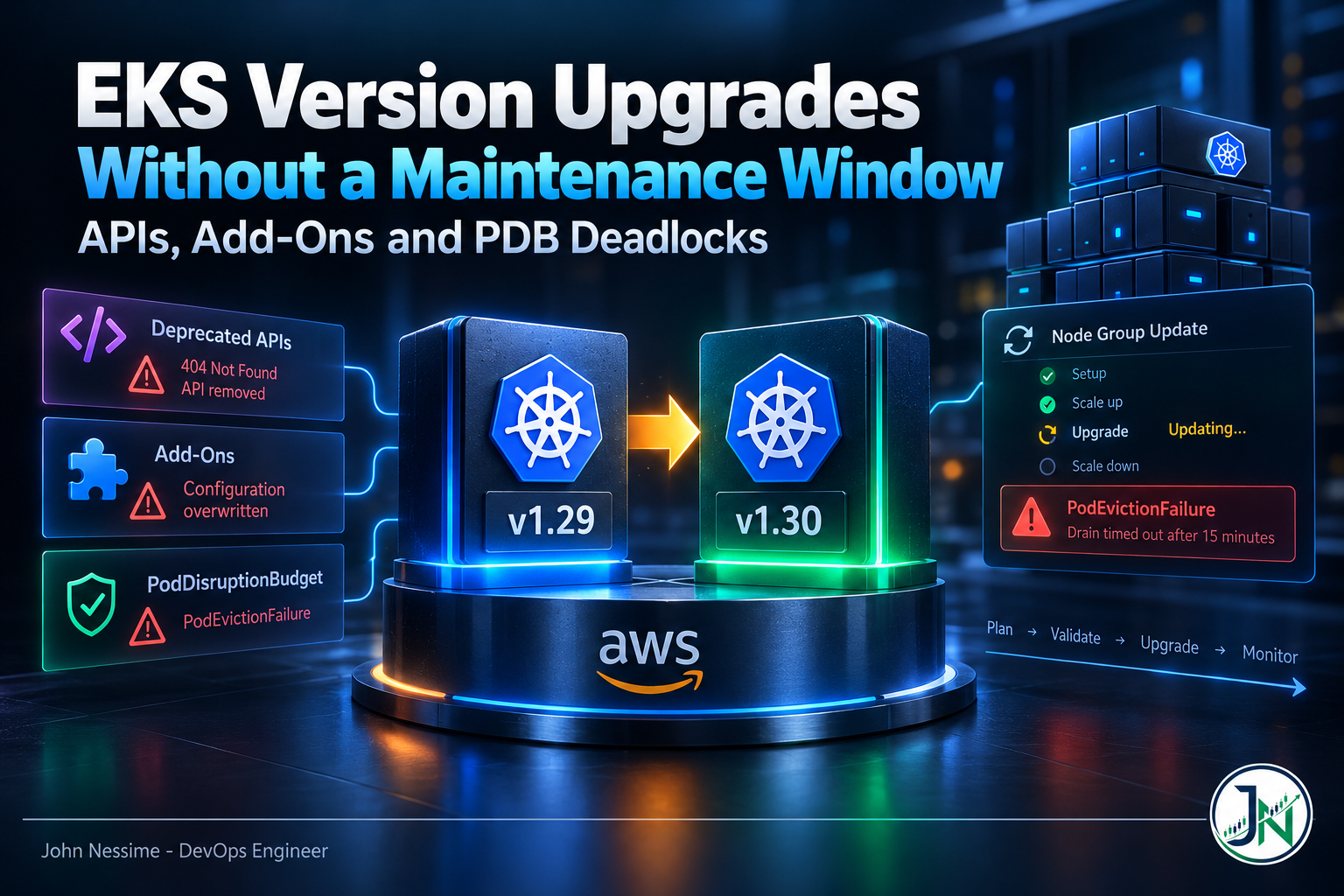
EKS Version Upgrades Without a Maintenance Window: APIs, Add-Ons and PDB Deadlocks

The control plane bump is the part AWS handles and almost never breaks. The damage happens in the data plane rollout afterwards. A practical walk through the three failure families that actually stall EKS version upgrades: removed APIs you did not know you were calling, add-on updates that silently discard your configuration, and pod disruption budgets that deadlock the node drain, plus what each escape hatch really costs.

Continue ReadingEKS Version Upgrades Without a Maintenance Window: APIs, Add-Ons and PDB Deadlocks

Zoho Mail Not Receiving Email? A DNS Troubleshooting Guide

Sending works, nothing comes in, and no bounce shows up anywhere. That asymmetry tells you almost everything: inbound mail is decided by MX records, not by SPF. This guide walks the inbound path in the order a sending server actually walks it, groups the real causes into five DNS failure families, and gives you the dig commands to prove which one you are looking at.

Continue ReadingZoho Mail Not Receiving Email? A DNS Troubleshooting Guide

Grafana Alert Notifications That Actually Arrive: Email, Slack and Telegram

The rule went red at 02:04 and nobody found out until 09:15. Rule evaluation and notification delivery are two different systems, and only one of them is visible in the UI. A practical setup for Grafana alert notifications to email, Slack and Telegram, plus how to detect the day delivery quietly stops.

Continue ReadingGrafana Alert Notifications That Actually Arrive: Email, Slack and Telegram

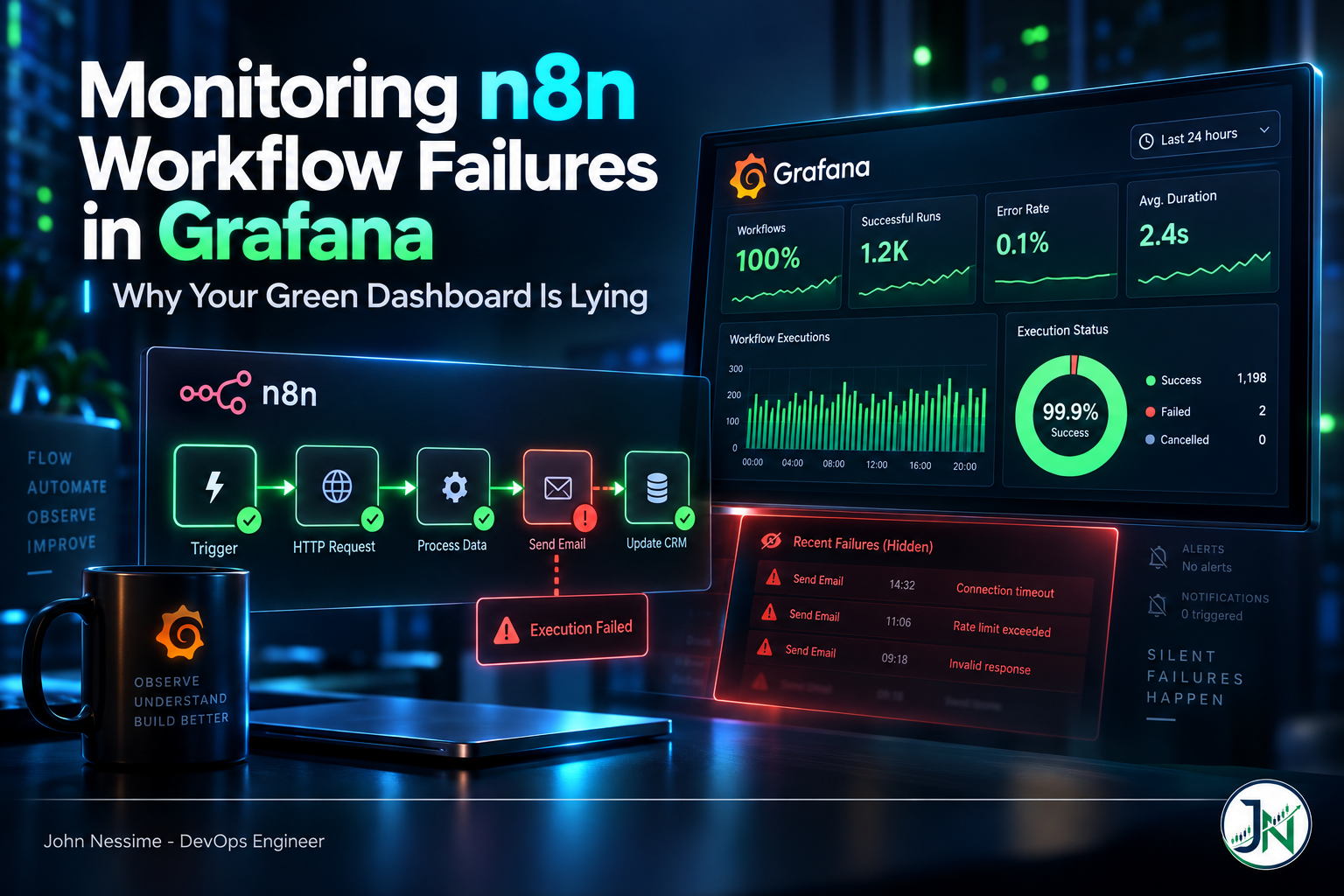
Monitoring n8n Workflow Failures in Grafana: Why Your Green Dashboard Is Lying

n8n's Prometheus endpoint tells you the process is alive and busy. It does not tell you a workflow stopped producing correct output. This post walks through the three failure families that slip past a default n8n dashboard, the PromQL that catches each one, and how to close the gap with a second source of truth from the executions API.

Continue ReadingMonitoring n8n Workflow Failures in Grafana: Why Your Green Dashboard Is Lying

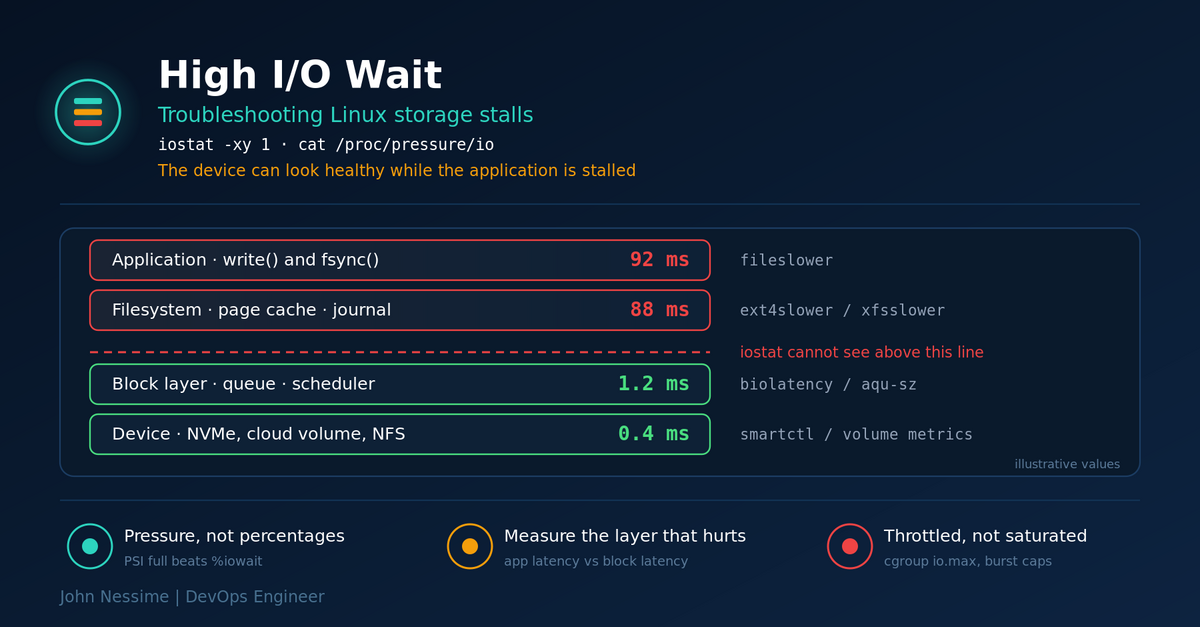
Troubleshooting High I/O Wait Without Blaming the Disk

High I/O wait is a symptom, not a diagnosis. It rises when nothing is wrong and stays flat when something is badly wrong, and it only sees one layer of the storage stack. This is how to read iowait and PSI correctly, then work through the five failure families that actually produce storage stalls: device saturation, memory pressure, synchronous writes, throttling, and latency that lives above the block layer entirely.

Continue ReadingTroubleshooting High I/O Wait Without Blaming the Disk